-

EU-US Data Transfers: Update February 2016
EU-US personal data transfers seem set to be permitted to continue under plans agreed between the EU Commission and US authorities. However, details are sketchy and the uncertainty created since the end of the Safe Harbor system seems likely to continue as national Data Protection Authorities and privacy activists remain unconvinced that the prospective scheme properly addresses the key issue of surveillance by US authorities.
UPDATE: On 16 July 2020, the EU Court of Justice decided that the EU-U.S. Privacy Shield framework could no longer be used to authorise transfers of personal data from the EU/EEA/UK to the USA, and other mechanisms need to be used.
-
Is Personal Data Now Risk? EU General Data Protection Regulation commentary - GDPR part 1
If you are in business you are processing data – so this applies to all of us. We have some time but clearly it would be a mistake to leave preparations until Easter 2018.
(May 2016: edited to include date of application)
(January 2017: edited to reflect draft E-Privacy Regulation)
(May 2018: edited to cover UK “data protection fee”) -
The Model Clauses are dead! Long live the Model Clauses!
“Model Clauses”; “Model Contracts”; “Standard Contractual Clauses”… For international transfers generally they remain entirely useable and legally valid. For transfers to the USA, now that Safe Harbor can’t be relied upon, they may still [December 2015] be the best option while awaiting a decision on what any successor arragements may look like.
-
Post Safe Harbor Transfers of Personal Data from EU to US: what to do?
The EU Court of Justice has ruled that we can no longer rely on the Safe Harbor scheme in order to permit transfers of personal data from the EU to the USA, whether to a third party or to a group company. If we haven’t already, the most immediate solution is to sign the European Commission’s Model Clauses…
-
Selling digital content to UK users - changes under the Consumer Rights Act 2015
From 1 October 2015, new specific rules apply to supplies of digital content to consumers. Time to review purchase flows and terms and conditions with end users, as well as contracts with suppliers. (Yes, again.)
-
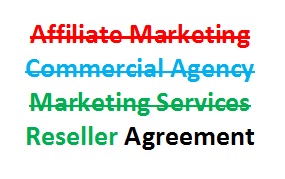
Can our affiliate marketers claim that they are commercial agents?
If we engage an external party to promote our products, then we could inadvertently create a commercial agency relationship and provisions in our contract may be overridden by laws that protect the agent. As ever, Eden Legal’s recommendation is to consider these matters at the outset. However, even after the fact there may be arguments on both sides.
-

Mobile World Congress MWC15 Special
Adam Farr of Eden Legal will be at the Mobile World Congress again in 2015. For 2015 what are some of the legal issues relevant to MWC?
-
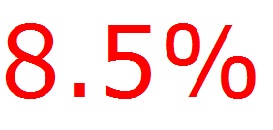
Can we charge interest on late payments?
Late payment is a problem for all. But if we are owed money, then late payment of commercial debts legislation may help us to claim interest and costs, and deter customers from delaying payment.
Update August 2016: UK interest rates were cut to 0.25% so the default intrest rate we can charge will be 8.25%.
-
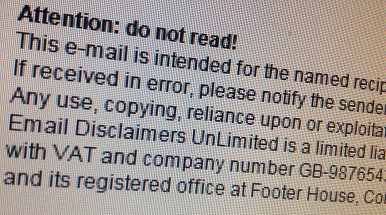
What information should we include in our email footers?
In emails there seems to be footer “inflation” and a lot of copying from others, without properly considering either the applicable obligations or the advisability of what is being said. Here we try to cut through this to what is legally required and/or useful to have.
-
What company information do we need to put on our website?
All you want to know is what details to put on your website. However, in the UK, the information is spread over various (overlapping) legal provisions.
-

You've been hacked - what are the legal issues?
We don’t want to be over-legalistic or moralistic. But paying a hacker and covering over the problem could turn out to be more damaging to you and your customers than dealing properly with the issue.
-
LDaaS - Legal Department as a Service
Eden Legal’s description of its services prompted one contact to coin the phrase “Legal Department as a Service”. We like that analogy and so here is a not-so-serious run down of some of the similarities – and not so similarities.
Call us on +34 6996 03 888
